A regulatory update lands on Monday morning.
A product that was acceptable last week now needs to be restricted. A state changes its rules. A sponsor bank updates its requirements. A card network introduces a new standard. Or your compliance team identifies a new transaction pattern that should no longer be allowed.
Now comes the harder question:
How long does it take to enforce that decision across 5,000 merchants?
For many payment organizations, the answer is uncomfortable.
The compliance team may understand the new requirement immediately. But turning that requirement into consistent action across thousands of merchant websites, product catalogs, transactions, and business models can take days or weeks.
That gap between knowing the rule and enforcing the rule is where compliance exposure grows.
The Real Challenge Is Not Writing the Rule
Large merchant portfolios rarely struggle because compliance teams cannot interpret a new requirement.
They struggle because enforcement is fragmented.
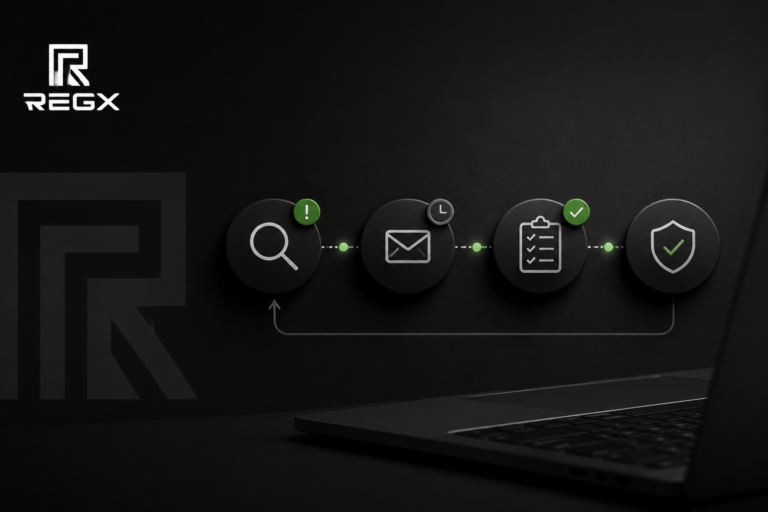
A new restriction may trigger a chain of work:
- Identify which merchants are affected.
- Determine which products, categories, claims, locations, or transactions fall under the new rule.
- Notify merchants.
- Request remediation.
- Review merchant responses.
- Recheck websites and catalogs.
- Update internal records.
- Escalate merchants that do not respond.
- Determine whether transactions should continue while remediation is pending.
Multiply that workflow by hundreds or thousands of merchants and a relatively simple rule change becomes an operational project.
The issue is not compliance knowledge.
It is compliance distribution.
5,000 Merchants Should Not Mean 5,000 Manual Actions
Traditional merchant compliance often operates merchant by merchant.
One analyst opens a website. Another reviews a product. Someone sends an email. A ticket is created. A spreadsheet is updated. The merchant makes a change. The analyst checks again.
That approach can work with a small portfolio.
At scale, it creates a structural problem: every new rule generates another wave of manual review.
If a rule affects 20% of a 5,000-merchant portfolio, that could mean 1,000 individual merchant cases requiring some level of attention.
And while those reviews are happening, transactions do not necessarily stop.
That distinction matters.
A compliance program can identify a problem without being able to prevent the associated transaction.
Detection Is Not the Same as Enforcement
Many compliance systems are designed to tell teams that something is wrong.
They generate alerts, cases, risk scores, monitoring results, or periodic reports.
Those functions are valuable, but a report produced after a transaction has already occurred does not answer the most important operational question:
Should this transaction have been allowed in the first place?
For acquiring banks, processors, PayFacs, and ISOs managing higher-risk merchant portfolios, compliance increasingly needs to operate closer to the transaction itself.
A new rule should not simply create more alerts.
It should change what the system allows.
What Centralized Rule Enforcement Looks Like
Imagine that a new restriction affects a particular product type in one jurisdiction.
Instead of asking hundreds of merchants to interpret and manually implement the restriction independently, the compliance organization defines the requirement centrally.
That rule can then become part of the decision logic used to evaluate activity across the portfolio.
The question changes from:
“Have all of our merchants implemented this correctly?”
to:
“Does activity across our portfolio comply with the rule we established?”
That is a fundamentally different operating model.
Compliance becomes a controlled infrastructure layer rather than a collection of merchant-by-merchant remediation projects.
Rules Can Be More Granular Than “Allow” or “Block”
Real-world merchant compliance is rarely binary.
A product may be acceptable nationally but restricted in certain states. A merchant may be permitted to sell a category but only under specific conditions. A transaction may be acceptable only if the underlying product, location, merchant status, or other compliance criteria meet defined requirements.
Effective rule enforcement therefore needs context.
Depending on the portfolio and vertical, rules can consider factors such as:
Merchant
Is this merchant approved for the activity being attempted?
Product
Is the item permitted under the applicable policy?
Geography
Is the product permitted where the buyer is located?
Compliance status
Does the merchant currently satisfy required controls?
Transaction context
Does this specific transaction meet the conditions established by the acquiring organization?
This is where transactional compliance differs from periodic merchant monitoring.
The compliance decision becomes part of whether the transaction proceeds.
Speed Matters When Regulations Change
Consider a portfolio with merchants operating across multiple regulated or higher-risk categories.
A state announces a new restriction that becomes effective shortly.
The compliance team may understand the change within hours.
But if enforcement depends on emails, support tickets, merchant development teams, individual website changes, screenshots, attestations, and subsequent reviews, implementation speed is largely outside the compliance team’s control.
That creates an important metric that payment organizations should start measuring:
Time to Enforcement
Not:
When did we learn about the rule?
Not:
When did we notify our merchants?
But:
When did the rule actually become enforceable across affected activity?
For a portfolio of 5,000 merchants, that difference can be significant.
Centralized Enforcement Also Creates Better Auditability
Speed is only half of the problem.
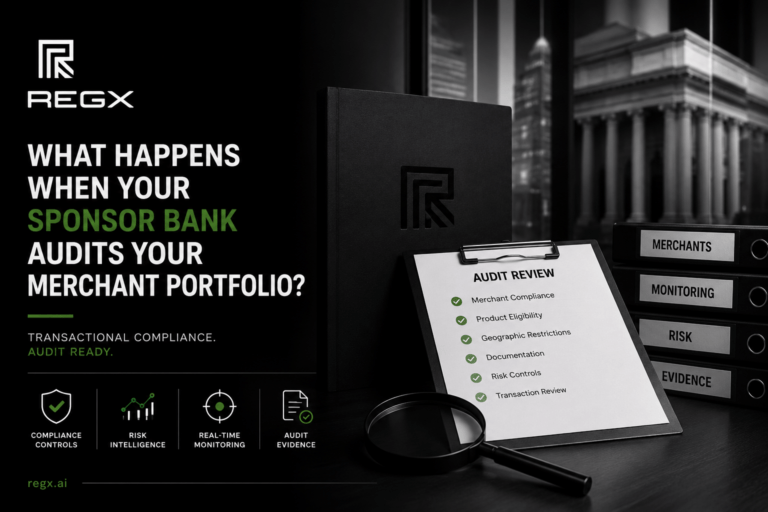
When a sponsor bank, regulator, internal auditor, or card network asks how a particular requirement was implemented, the compliance team needs to demonstrate more than an email campaign.
They may need to answer:
- Which merchants were affected?
- When was the rule implemented?
- What activity did the rule cover?
- How was the rule enforced?
- What happened when activity violated the rule?
- Can the organization demonstrate consistent application across the portfolio?
A centralized rule structure creates a clearer record of the relationship between policy, enforcement, and transaction outcomes.
Instead of proving that thousands of merchants were individually told what to do, the organization can demonstrate how the requirement was operationalized.
This Changes the Economics of Compliance
Merchant portfolios are growing faster than most compliance teams can grow.
If every additional merchant increases compliance workload proportionally, scaling the portfolio eventually means scaling headcount alongside it.
The same problem appears whenever regulations change.
More rules × more merchants × more jurisdictions = more manual work.
Centralized transactional compliance changes that equation.
The objective is not to eliminate compliance professionals. It is to stop using highly skilled compliance teams for repetitive implementation work that can be standardized.
Analysts can focus on interpreting requirements, investigating meaningful exceptions, managing risk, and establishing policy.
The infrastructure handles consistent execution.
From Monitoring Merchants to Controlling Transactional Compliance
There is an important difference between knowing what is happening across a merchant portfolio and controlling what is permitted to happen.
Monitoring answers:
“What did we find?”
Transactional compliance asks:
“Should this transaction be allowed?”
For organizations managing thousands of merchants, the second question becomes increasingly important.
Because when the next regulatory change arrives, the goal should not be to launch a 5,000-merchant remediation campaign.
The goal should be to translate the requirement into enforceable logic and apply it consistently across the relevant portfolio.
That is the model behind RegX.
RegX provides transactional compliance infrastructure for acquiring banks, processors, PayFacs, and ISOs, helping organizations turn compliance requirements into rules that can be applied across merchant activity.
When a rule changes, the real measure of your compliance infrastructure isn’t how quickly your team sends the notification.
It’s how quickly the new rule becomes enforceable.
Learn more at regx.ai.