Finding a merchant compliance issue is only the beginning.
A prohibited product appears on a website. A claim changes. A required disclosure disappears. A merchant begins selling into a restricted jurisdiction. Something that was compliant during underwriting is no longer compliant today.
The monitoring system catches it.
What happens next?
For many acquiring organizations, that is where the process becomes surprisingly manual: screenshots, emails, spreadsheets, tickets, follow-ups, another review, another email.
But identifying a problem and resolving it are two very different compliance functions.
A strong merchant remediation workflow should create a clear path from issue detected → merchant notified → corrective action → verification → resolution or escalation.
More importantly, it should leave evidence of every step.
What Is Merchant Remediation?
Merchant remediation is the process used to correct a compliance issue after it has been identified within a merchant account.
Depending on the violation, remediation might require a merchant to:
- Remove a prohibited product
- Change product descriptions or marketing claims
- Add required disclosures
- Correct age restrictions
- Update certificates or supporting documentation
- Stop selling into restricted jurisdictions
- Correct checkout or transactional controls
- Remove prohibited terminology
- Provide evidence supporting a product or business activity
The objective is not simply to tell the merchant that something is wrong.
The objective is to bring the merchant back into compliance—and establish that the problem was actually corrected.
That distinction matters.
A Compliance Alert Is Not a Remediation Workflow
Imagine a monitoring system identifies a prohibited claim on a merchant’s website.
An analyst receives the alert.
The analyst emails the merchant.
Three days later, the merchant responds saying the issue has been fixed.
Is the case closed?
It shouldn’t be.
Someone still needs to verify the change. The original violation needs to be documented. The merchant’s response needs to be retained. The resolution needs to be recorded. And if the merchant did not correct the issue, somebody needs to determine what happens next.
Without that structure, remediation becomes dependent on individual analysts remembering what to check, when to follow up, and where to document it.
That becomes increasingly difficult as the merchant portfolio grows.
What a Good Merchant Remediation Workflow Looks Like
A strong remediation process has several distinct stages.
1. Identify the Specific Violation
A useful remediation case begins with specificity.
“Website compliance issue” isn’t enough.
The case should identify what changed, where it was found, what requirement it conflicts with, and what evidence supports the finding.
For example:
Issue: Prohibited product claim detected
Location: Product page
Evidence: Page content captured during monitoring
Requirement: Merchant cannot make the identified claim under the applicable program
Detected: Date and time of detection
This gives both the compliance team and the merchant a clear understanding of what needs to be corrected.
It also creates a record of what existed when the violation was identified.
2. Assign Severity and Required Action
Not every compliance issue should be treated equally.
A missing disclosure may require a different response than a prohibited product or transaction occurring in a restricted jurisdiction.
A mature workflow should classify issues based on factors such as severity, regulatory exposure, card-brand or bank requirements, transaction activity, merchant history, and whether the issue can be remediated while processing continues.
The classification should determine what happens next.
A lower-level issue might generate a standard remediation request with a defined deadline.
A more serious violation could require immediate escalation, transactional restrictions, additional review, or suspension depending on the acquiring organization’s policies.
This prevents teams from treating every alert as either an emergency or a routine administrative task.
3. Tell the Merchant Exactly What Needs to Change
A remediation notice should be actionable.
Instead of:
Your website is not compliant. Please make the necessary changes.
The merchant should receive enough information to understand the issue and the expected correction.
That includes the affected page, product, claim, document, or control; the reason it was flagged; the required corrective action; and the deadline for remediation.
Clear instructions reduce unnecessary back-and-forth and make it easier to determine later whether the merchant actually complied with the request.
4. Set a Remediation Deadline
Every open compliance issue should have an owner and a deadline.
Otherwise, remediation cases can remain unresolved indefinitely.
The appropriate deadline will depend on the severity of the violation and the organization’s policies. What matters operationally is that the deadline is tracked.
The compliance team should be able to answer:
Which merchants currently have open remediation cases? Which are approaching their deadlines? Which are overdue?
If answering those questions requires checking individual emails or spreadsheets, the workflow is already creating unnecessary operational risk.
5. Verify the Correction Independently
This is one of the most important parts of remediation.
A merchant saying “fixed” should not automatically close a case.
The correction needs to be verified.
If the issue involved website content, the relevant page should be checked again. If it involved documentation, the replacement document should be reviewed. If it involved a transactional restriction, the control should be validated.
The workflow should capture the result of that verification.
This creates an important separation between merchant-reported remediation and verified remediation.
6. Recheck the Transactional Environment
Website remediation alone may not tell the entire story.
Suppose a merchant removes a prohibited product after receiving a compliance notice.
Was the product actually prevented from being sold?
Were transactions associated with that product already processed?
Could the merchant continue accepting prohibited transactions through another URL, checkout flow, product identifier, or channel?
For acquiring banks and payment organizations, remediation should ultimately connect back to transaction risk.
This is where transactional compliance becomes important.
The goal is not simply to maintain a website that appears compliant during a review. It is to understand whether the merchant’s actual commercial activity remains within the parameters the acquiring organization has approved.
7. Escalate Repeated or Unresolved Violations
A merchant that corrects an accidental issue immediately presents a different risk profile from a merchant that repeatedly receives the same remediation notice.
Good workflows preserve that history.
If the merchant does not remediate within the required period—or repeatedly reintroduces the same issue—the case should move through a defined escalation path.
Depending on internal policy, that could include additional monitoring, enhanced review, transaction restrictions, reserve or risk review, temporary suspension, or termination.
The important part is consistency.
Escalation should be based on established rules and documented merchant behavior rather than whichever analyst happens to be handling the case.
The Remediation History Matters as Much as the Individual Violation
Looking at violations individually can hide a larger problem.
Imagine a merchant receives five compliance alerts over six months.
Every issue is eventually corrected.
On paper, every case says resolved.
But the merchant has demonstrated a repeated pattern of non-compliance.
That history may be far more relevant to the acquiring bank than any single violation.
A good remediation system therefore needs to preserve more than the current status of a case. It should make it possible to understand the merchant’s compliance behavior over time.
How frequently are violations occurring?
Are they the same type of violation?
How quickly does the merchant remediate?
Are issues becoming more serious?
Does the merchant repeatedly restore prohibited content after remediation?
Those patterns turn remediation data into risk intelligence.
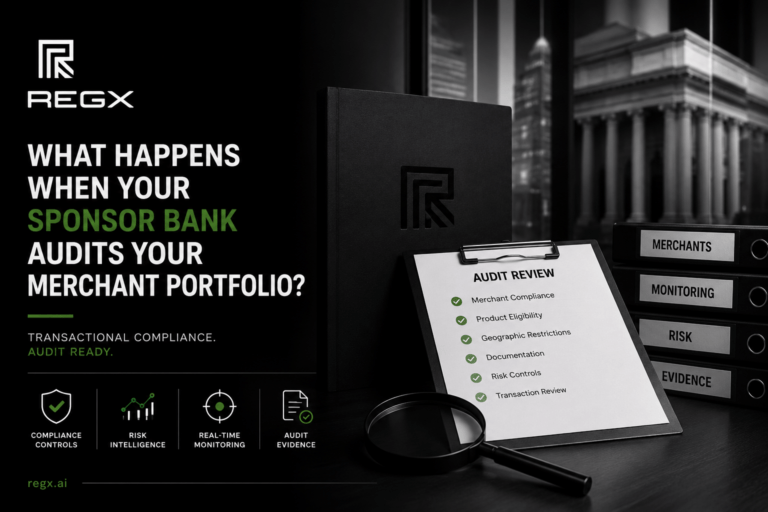
Your Remediation Workflow Should Also Be Audit-Ready
There is another reason remediation records matter.
When a sponsor bank, card brand, regulator, or internal auditor reviews a merchant portfolio, the question may not simply be:
“Did you find compliance violations?”
The more important questions are often:
“What did you do when you found them?”
A defensible remediation record should make it possible to reconstruct the lifecycle of a compliance issue:
Detection → Evidence → Notification → Merchant Response → Corrective Action → Verification → Resolution or Escalation
That record demonstrates that monitoring resulted in actual compliance action.
A folder full of screenshots proves that issues were observed.
A documented remediation workflow proves that they were managed.
Where Merchant Remediation Breaks Down
The biggest problems usually appear in the handoffs.
One system generates an alert.
Another person sends the email.
The merchant replies to a shared inbox.
Someone updates a spreadsheet.
Another analyst checks the website.
A manager decides whether to escalate.
Evidence lives somewhere else.
Each individual step may work. The problem is that the organization does not have one continuous record connecting them.
At portfolio scale, those gaps create operational problems: missed deadlines, inconsistent enforcement, duplicate reviews, unresolved cases, limited visibility into repeat offenders, and difficulty demonstrating what happened during an audit.
The solution is not simply more monitoring.
It is connecting monitoring to action.
From Monitoring to Transactional Compliance
Merchant compliance should not end when a system detects something suspicious.
The real objective is to determine whether the merchant remains within the conditions under which it was approved—and what should happen when it does not.
That requires monitoring, remediation, verification, escalation, historical intelligence, and transactional controls to work together.
RegX is built around that lifecycle.
Rather than treating compliance as a collection of alerts, RegX helps acquiring organizations operationalize compliance across the merchant portfolio—connecting merchant activity and risk intelligence to the decisions that determine whether transactions should be allowed to happen.
Because detecting a compliance problem is useful.
Knowing what happened next is what makes the compliance program defensible.