


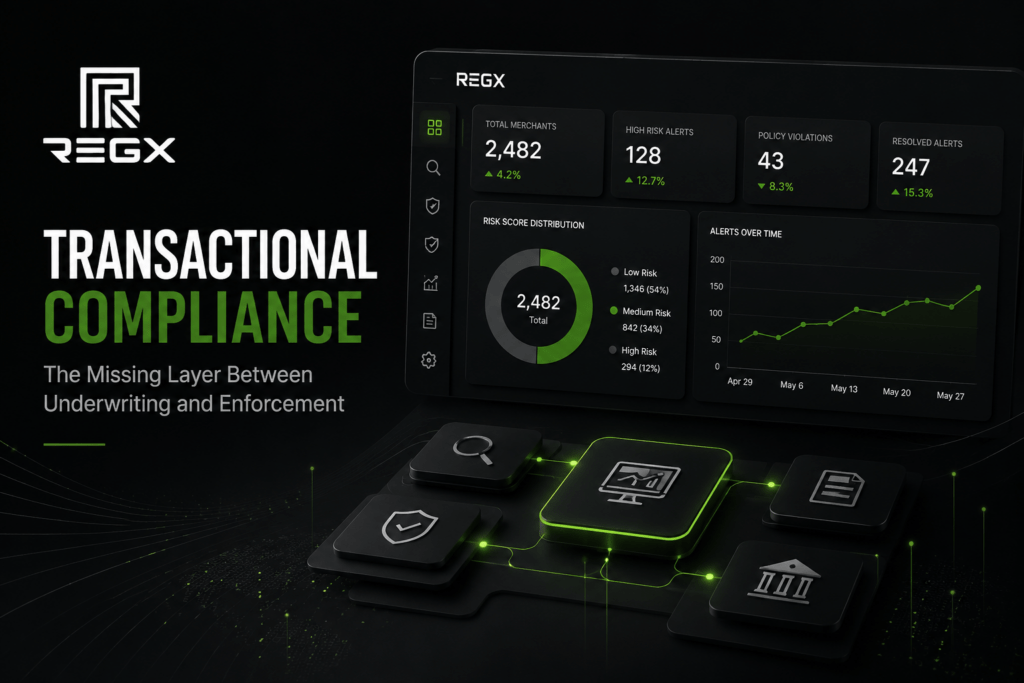
For years, compliance programs in payments have focused on two primary functions: underwriting merchants before approval and enforcing violations after they are discovered.
The challenge is that most compliance failures occur somewhere in between.
A merchant passes underwriting. The account is approved. Processing begins. Months later, a bank discovers prohibited products, unsupported claims, missing disclosures, or activity that no longer aligns with the merchant profile originally reviewed.
At that point, enforcement begins.
But by then, the exposure already exists.
This growing gap has created a need for a new approach: transactional compliance.
The Traditional Compliance Model
Most payment companies have invested heavily in onboarding controls.
Underwriters review websites, product catalogs, business documentation, marketing materials, and ownership information before making an approval decision.
The process is designed to answer a simple question:
“Is this merchant compliant today?”
The problem is that merchant businesses are not static.
Websites change. Product lines expand. Regulations evolve. Marketing teams publish new content. Third-party vendors update pages. New categories appear.
The merchant that was compliant during onboarding may look very different 30, 60, or 180 days later.
Traditional underwriting was never designed to monitor those changes continuously.
The Enforcement Problem
When ongoing monitoring is limited, violations are often discovered only after an external event occurs.
A consumer complaint may trigger a review.
A regulator may issue a warning.
A card network inquiry may raise concerns.
An acquiring bank may conduct a portfolio audit.
Only then does enforcement begin.
The issue is not that enforcement is ineffective. The issue is timing.
Enforcement is inherently reactive. It addresses exposure after it already exists.
By the time a violation is identified, the processor, ISO, PayFac, or acquiring bank may have already accumulated weeks or months of risk exposure.
What Is Transactional Compliance?
Transactional compliance fills the gap between underwriting and enforcement.
Rather than treating compliance as a one-time approval process, transactional compliance continuously evaluates merchant activity against regulatory requirements, network rules, underwriting expectations, and internal risk policies.
The goal is not simply to detect violations.
The goal is to identify changes before they become portfolio-wide problems.
This shifts compliance from periodic review to continuous oversight.
Instead of asking whether a merchant was compliant during onboarding, transactional compliance asks whether the merchant remains compliant today.
Why Merchant Risk Changes Over Time
One of the most overlooked realities in payments is that merchant risk is dynamic.
A CBD merchant may introduce a new cannabinoid product.
A kratom seller may add 7-OH products after approval.
A wellness merchant may begin using marketing language that creates regulatory concerns.
A supplement company may launch entirely new product categories without notifying its processor.
None of these changes require a new underwriting application.
Yet each one can significantly alter the risk profile of the account.
Without continuous visibility, these changes can remain unnoticed until an audit, complaint, or regulatory inquiry occurs.
Monitoring Is Not the Same as Compliance
Many organizations already use monitoring tools.
They receive alerts when websites change, new products are added, or keywords appear.
While monitoring is important, alerts alone do not create compliance.
An alert identifies a potential issue.
Compliance requires understanding whether the issue violates a rule, assessing the level of exposure, documenting the finding, and taking appropriate action.
This distinction is becoming increasingly important as payment portfolios grow and compliance teams are expected to oversee thousands of merchants simultaneously.
The challenge is not finding more alerts.
The challenge is converting alerts into meaningful compliance decisions.
The Business Impact of Transactional Compliance
For processors, ISOs, PayFacs, and acquiring banks, transactional compliance creates several advantages.
First, it reduces the likelihood of exposure accumulating unnoticed across a portfolio.
Second, it provides greater visibility into merchant behavior after approval.
Third, it creates a documented compliance trail that can support audits, bank reviews, and regulatory inquiries.
Most importantly, it allows organizations to address issues while they are still manageable.
Finding a problem during its first day is very different from discovering it six months later.
The earlier a compliance issue is identified, the more options exist to resolve it.
The Future of Compliance Operations
As high-risk industries continue to evolve, compliance can no longer be viewed as a point-in-time activity.
The traditional model of underwriting first and enforcement later leaves a significant blind spot between approval and discovery.
That blind spot is where many compliance failures originate.
Transactional compliance addresses this challenge by creating continuous visibility into merchant activity throughout the life of the account.
For payment companies operating in regulated or high-risk industries, it is quickly becoming the missing layer between underwriting and enforcement.
The organizations that embrace this approach will be better positioned to identify risk earlier, respond faster, and maintain stronger control over portfolio exposure as regulatory expectations continue to increase.
RegX helps processors, ISOs, PayFacs, and acquiring banks implement transactional compliance by continuously monitoring merchant activity, identifying compliance risks, and providing actionable visibility across the entire portfolio.